

Key takeaways
- Best overall for travel: Samsung T7 Shield
- Best compact budget option: Kingston XS1000
- Best for a slim, polished everyday drive: Crucial X9 Pro
- Best for maximum USB 3.2 Gen 2×2 speed: Kingston XS2000
- Best for demanding video workflows: Crucial X10 Pro, when your computer supports USB 3.2 Gen 2×2
- Best for a broad device ecosystem: Samsung T7 Shield or Samsung T7
The best portable SSD for most people is the Samsung T7 Shield: it combines fast everyday transfers, USB-C compatibility, IP65 protection, hardware encryption, and a compact design without reaching the price of premium 2,000 MB/s drives.
The right choice changes with your laptop, phone, camera, and travel habits. A drive that reaches 2,000 MB/s on a compatible USB 3.2 Gen 2×2 computer may transfer no faster than a 1,000 MB/s model on an older USB-C port. The comparisons below focus on real-world ownership factors rather than headline speed alone.
Our top picks
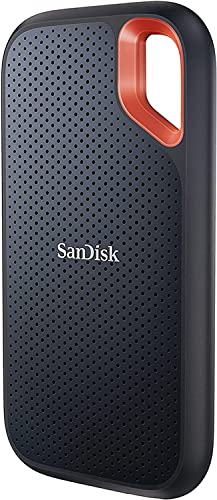

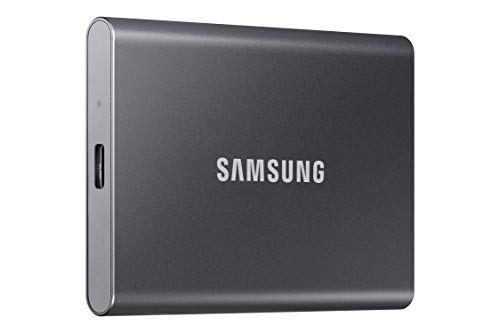

As an Amazon Associate we earn from qualifying purchases at no extra cost to you. Ratings are shown as listed on Amazon.
Best portable SSDs by situation
- Best overall for travel: Samsung T7 Shield
- Best compact budget option: Kingston XS1000
- Best for a slim, polished everyday drive: Crucial X9 Pro
- Best for maximum USB 3.2 Gen 2×2 speed: Kingston XS2000
- Best for demanding video workflows: Crucial X10 Pro, when your computer supports USB 3.2 Gen 2×2
- Best for a broad device ecosystem: Samsung T7 Shield or Samsung T7
Head-to-head comparison
| Drive | Capacities | Advertised sequential speed | Approx. size and weight | Protection and encryption | Warranty |
|---|---|---|---|---|---|
| Samsung T7 Shield | 1TB, 2TB, 4TB | Up to 1,050 MB/s read; 1,000 MB/s write | 88 × 59 × 13 mm; 98 g | IP65; AES 256-bit hardware encryption | 3 years |
| Crucial X9 Pro | 1TB, 2TB, 4TB | Up to 1,050 MB/s read and write | 65 × 50 mm; 38 g | IP55; AES 256-bit hardware encryption | 5 years |
| Kingston XS1000 | 1TB, 2TB | Up to 1,050 MB/s read; 1,000 MB/s write | 69.5 × 32.6 × 13.5 mm; 28.7 g | No stated IP rating; hardware encryption depends on host software or operating system | 5 years |
| Kingston XS2000 | 500GB, 1TB, 2TB, 4TB | Up to 2,000 MB/s read and write | 69.5 × 32.6 × 13.5 mm; 28.9 g | IP55 with included rubber sleeve; no dedicated hardware encryption feature | 5 years |
| Crucial X10 Pro | 1TB, 2TB, 4TB | Up to 2,100 MB/s read; 2,000 MB/s write | 65 × 50 mm; 42 g | IP55; AES 256-bit hardware encryption | 5 years |
Dimensions, weights, capacities, ratings, speeds, and warranty terms are manufacturer specifications. Actual transfer performance varies with the computer, cable, file size, free space, temperature, and workload.
Samsung T7 Shield: the safest all-round travel choice
The T7 Shield is the most balanced pick when a drive will regularly move between a home computer, work laptop, tablet, or camera bag. Its rubberized exterior and IP65 rating protect against dust and water jets, although IP65 is not an invitation to submerge it. It is also resistant to ordinary bumps and drops better than a bare metal enclosure.
Its USB 3.2 Gen 2 connection tops out at about 1,000 MB/s in favorable conditions. That is fast enough to copy a 100GB folder in roughly two minutes under ideal sustained conditions, but mixed folders with thousands of small files can take substantially longer. The drive supports password protection through Samsung’s software and AES 256-bit hardware encryption. It includes USB-C-to-C and USB-C-to-A cables, which is useful when connecting to older computers.
Choose the 2TB version for a travel photo library or regular video transfers. The 4TB model is convenient for a large media collection, but compare its price with two smaller drives if backup redundancy matters more than convenience.
Crucial X9 Pro: compact, capable, and backed by a long warranty
The X9 Pro is a strong choice for everyday storage when you want a small drive with a five-year warranty. It is shorter and lighter than the T7 Shield, has an IP55 rating, and reaches approximately 1,000 MB/s with a suitable USB 3.2 Gen 2 port. Its aluminum-and-rubber construction is travel friendly, though its lower ingress rating gives the Samsung an advantage in dusty or wet environments.
The X9 Pro includes password protection and AES 256-bit hardware encryption through compatible software. It is particularly appealing for people who carry documents, a working photo catalog, or a portable project library rather than a full desktop backup. Its integrated lanyard loop is a small but useful detail: attaching the drive to a pouch reduces the chance of leaving it behind at a shared workspace.
Kingston XS1000: the tiny budget-friendly option
The XS1000 is among the easiest portable SSDs to carry. At about 29 grams, it is closer to the weight of a few keys than a traditional external hard drive. It delivers roughly 1,000 MB/s-class performance and includes a USB-C cable plus a USB-C-to-USB-A adapter.
This is the practical pick for a student, commuter, or occasional backup user who values size and price more than water resistance. Its main limitation is the lack of a stated IP rating and a dedicated hardware-encryption feature. Use operating-system encryption, an encrypted disk image, or file-level encryption for sensitive data, and keep the drive in a protective pouch rather than loose in a bag.
Kingston XS2000 and Crucial X10 Pro: when 2,000 MB/s is worthwhile
The XS2000 and X10 Pro are designed for USB 3.2 Gen 2×2 systems, where their advertised speeds can approach 2,000 MB/s. That interface is not universal: many USB-C ports support only 5 or 10 Gbps, and Thunderbolt ports do not automatically deliver USB 3.2 Gen 2×2 performance. Check the computer’s specifications before paying extra for this tier.
The XS2000 is exceptionally small and includes a removable rubber sleeve for extra protection. The X10 Pro is slightly larger but adds hardware encryption and a five-year warranty. Either can help with large video projects, virtual machines, or frequent transfers of multi-gigabyte files. For ordinary documents and photo backups, the difference is less noticeable because the slower part may be the source drive, the cable, or the number of small files.
How to choose capacity without overspending
- 500GB: suitable for documents, applications, and a modest active project, but usable space will be lower after formatting.
- 1TB: the best starting point for most people; enough for work files, photos, and several large projects.
- 2TB: the sensible choice for video editors, photographers, and anyone who wants room for growth.
- 4TB: useful as a consolidated library, but do not treat a single large drive as your only backup.
A simple planning calculation helps. If your camera or phone creates 20GB per week, a 1TB drive has roughly 50 weeks of nominal capacity after allowing about 10 percent for overhead and leaving free space for performance. If you also keep three 100GB active video projects, 2TB is the more comfortable choice. Avoid filling an SSD to the last few percent; leaving at least 10 to 15 percent free can help sustained write behavior and file management.
Connector compatibility matters more than the label
USB-C describes the connector shape, not the speed. A drive connected to a USB 3.2 Gen 1 port may operate around 400–500 MB/s, while a USB 3.2 Gen 2 port can approach 1,000 MB/s. Gen 2×2 is required for approximately 2,000 MB/s-class performance. The supplied cable also matters: use the rated cable, keep it short, and replace cables that disconnect when moved.
For phones and tablets, check power requirements and operating-system support. Some mobile devices can read an SSD but cannot supply enough power for reliable sustained writing. A powered hub may help, but it adds bulk and another failure point. For camera recording, verify that the camera supports external SSD recording and that its cable and file-system requirements match the drive.
Durability and ownership realities
Portable SSDs have no spinning platters, but they are not indestructible. The USB connector, cable, enclosure seams, and flash memory are the parts most likely to cause trouble over time. Repeatedly bending the cable at the connector can create intermittent failures. Keep the drive cool, avoid covering it during long transfers, and eject it before unplugging whenever the operating system provides that option.
Water resistance applies only when the port cover or enclosure is properly closed. IP ratings describe controlled conditions, not salt water, condensation, washing machines, or impact combined with water. A protective pouch is still worthwhile, especially for an unrated drive such as the XS1000.
Use the drive as one copy in a backup plan, not as the plan itself. A practical routine is to keep the working files on the computer, copy them to the portable SSD, and maintain a second copy on another drive or a trusted backup service. Every few months, open representative files and check the drive’s health with the manufacturer’s utility or your operating system.
Final buying decision
Buy the Samsung T7 Shield if travel protection, broad cable compatibility, and encryption are your priorities. Choose the Crucial X9 Pro for a lighter everyday drive with a five-year warranty. Pick the Kingston XS1000 when the smallest size and lower general market price matter most. Choose the Kingston XS2000 or Crucial X10 Pro only when your computer supports USB 3.2 Gen 2×2 and you regularly move very large files. In every case, buy enough capacity to leave free space and keep a separate backup of anything you cannot replace.








Write Your Review
No reviews yet. Be the first to share your experience!