

Key takeaways
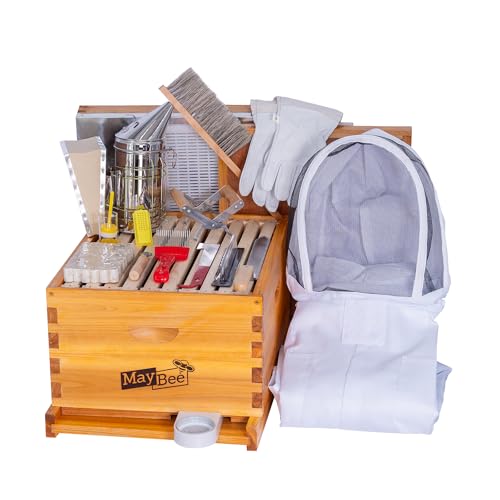
- One hive body, preferably with at least two boxes for a colony that grows quickly.
- Eight or 10 matching frames per box, with wax or plastic foundation.
- A screened bottom board or solid bottom board, depending on the management plan.
- An inner cover and a telescoping or migratory outer cover.
- Entrance reducer and hive stand, or clear instructions for supplying them separately.
- A hive tool and smoker. A bee brush is useful but not essential.
- Protective clothing: veil, gloves, and a ventilated jacket or suit.
- Assembly hardware and instructions that identify every component.
The best beehive starter kits for new beekeepers are usually complete 8-frame or 10-frame Langstroth kits with assembled, unpainted wooden boxes, standard foundation, a screened bottom board, an inner cover, an outer cover, and properly sized protective clothing; choose a top-bar or Warre kit only if you specifically want a different management style.
Our top picks



As an Amazon Associate we earn from qualifying purchases at no extra cost to you. Ratings are shown as listed on Amazon.
Best beehive starter kits by beginner situation
| Situation | Best choice | Why it fits | Typical initial cost |
|---|---|---|---|
| Most first-year beekeepers | 8-frame Langstroth kit | Lighter boxes, widely available parts, straightforward inspection | $250–$500 before bees |
| Maximum equipment compatibility | 10-frame Langstroth kit | The most common format, with broad frame and box availability | $275–$550 before bees |
| Limited lifting strength | 8-frame Langstroth or top-bar hive | Smaller individual lifts; top-bar comb is managed one bar at a time | $250–$700 before bees |
| Small apiary and low-cost woodworking | Standard Langstroth kit with flat-pack boxes | Replacement parts and extra boxes are inexpensive and easy to find | $180–$400 before bees and clothing |
| Minimal lifting and no frame wiring | Top-bar hive kit | Individual bars are light and do not require stacked boxes | $300–$800 before bees and clothing |
Langstroth, top-bar, or Warre: which hive style is easiest?
Langstroth hives: the safest default
Langstroth hives use removable rectangular frames in stacked boxes. The 8-frame and 10-frame versions share the same basic management approach, so instructional material, local mentors, nucleus colonies, replacement frames, and honey equipment are generally easy to match.
An 8-frame box is narrower and usually lighter. A full deep box can approach 60–90 pounds depending on wood, moisture, bees, and stored honey, while a full 10-frame deep can be heavier. Those are practical handling differences: beginners often find an 8-frame hive easier to inspect without twisting or overreaching.
A 10-frame setup offers more capacity and may be preferable where local beekeepers commonly use that format. Do not mix 8-frame and 10-frame boxes simply because their outside dimensions look similar; the frames, ledges, and box widths are not interchangeable.
Top-bar hives: less lifting, different skills
Top-bar hives use individual horizontal bars rather than rectangular frames. They avoid lifting a heavy honey-filled box, but the comb is more delicate and cannot always be handled or transported like Langstroth comb. A kit should include accurately spaced bars, a stable stand, a roof, and a follower board. Beginners need to learn how to remove bars without crushing attached comb.
Warre hives: compact, but not the simplest teaching platform
Warre hives are vertically stacked boxes managed with a different philosophy and equipment set. They can suit someone committed to that method, but they are less convenient for beginners who expect standard Langstroth frames, common local advice, or conventional honey extraction. Choose one because you want the Warre system, not because the box price alone is lower.
What a genuinely useful starter kit should include
Compare the parts list rather than the word “complete.” A practical Langstroth starter kit should contain:
- One hive body, preferably with at least two boxes for a colony that grows quickly.
- Eight or 10 matching frames per box, with wax or plastic foundation.
- A screened bottom board or solid bottom board, depending on the management plan.
- An inner cover and a telescoping or migratory outer cover.
- Entrance reducer and hive stand, or clear instructions for supplying them separately.
- A hive tool and smoker. A bee brush is useful but not essential.
- Protective clothing: veil, gloves, and a ventilated jacket or suit.
- Assembly hardware and instructions that identify every component.
Many inexpensive kits include only one deep box, eight or 10 frames, and covers. That may be a hive body rather than a working starter system. You may still need a second box, feeder, protective clothing, smoker fuel, paint, a stand, and a source of bees.
Wood quality and assembly: what to inspect before buying
For outdoor durability, look for kiln-dried cedar or pine with straight edges, sound joints, and no large knots at frame rests. Cedar naturally resists weathering, while pine is usually less expensive and works well when protected with exterior paint. Either material can last for years if it is kept off wet ground and painted on the outside only.
Check the thickness and fit of the box walls. Thin panels can warp, split around nails, or make the box difficult to lift once propolized. Frame rests should be square and smooth; rough or inaccurate rests can cause frames to sit too close together, encouraging burr comb.
Flat-pack boxes reduce shipping cost but require careful assembly. Allow roughly 30–60 minutes per box for a first build, plus drying time for exterior paint. Preassembled boxes cost more but reduce the chance of misaligned joints. Avoid painting interior surfaces or frame contact areas, because paint can contaminate working surfaces and interfere with bee space.
Frames, foundation, and expansion options
Wax foundation can help bees establish orderly comb, but it can sag in heat and needs careful storage. Plastic foundation is more uniform and durable, though bees may accept it more slowly if it is not coated with wax. A beginner-friendly kit should use a standard frame size and make it easy to buy additional frames locally.
Expansion matters more than the first box. A colony may need another brood box or a honey super during the season, depending on climate, nectar flow, colony strength, and local practice. Before buying, confirm that the manufacturer sells matching boxes, frames, covers, and replacement parts. Proprietary dimensions can turn a modest initial saving into an expensive long-term limitation.
For a typical 8-frame Langstroth hive, plan for two brood boxes and at least one shallow or medium honey super as a practical expansion path. The exact configuration varies by region. A local beekeeping association can tell you which box depth and frame type are easiest to exchange or borrow nearby.
Protective gear: fit is more important than appearance
A veil that touches your face, loose cuffs, or an unzipped jacket can create more risk than a plain, well-fitting suit. Choose a ventilated jacket or suit with elastic wrists and ankles, a secure zipper, and a veil that stays rigid when you bend over. Gloves should allow enough dexterity to grip a frame, but beginners may prefer thicker gloves while learning.
Measure your chest, waist, sleeve, inseam, and head circumference against the manufacturer’s chart. Leave room for a shirt or light layer. A suit that is too small can pull the veil toward your face; one that is excessively loose can snag on equipment.
Keep closed shoes or boots available. Open footwear and short sleeves are poor substitutes for properly fitted protective equipment, particularly during inspections when bees may become defensive.
Ownership costs and maintenance realities
A realistic first-year budget often looks like this:
- Hive hardware: $180–$550, depending on style and whether boxes are assembled.
- Protective clothing: $80–$250.
- Tools and smoker: $40–$120.
- Feeder, stand, paint, and small supplies: $50–$150.
- Bees: commonly $120–$250 or more for a package or nucleus colony, depending on region and season.
Wooden boxes and covers usually outlast frames. Frames wear first because wax accumulates, propolis makes them difficult to clean, and comb can become dark or contaminated over repeated brood cycles. Many beekeepers replace old brood comb gradually rather than trying to preserve it indefinitely. Smoker bellows, veil zippers, glove fingertips, and plastic foundation are also common replacement items.
Store spare boxes dry and ventilated. Scrape propolis from box edges and frame rests, check covers for leaks, and repair cracked wood before winter. Never leave painted equipment sitting directly on soil. A simple stand that keeps the bottom board several inches above the ground improves access and reduces moisture exposure.
Common starter-kit mistakes
- Buying a “complete” kit without checking whether it includes frames and foundation.
- Choosing 10-frame equipment when repeated heavy lifting is unrealistic.
- Mixing box depths or frame sizes from different systems.
- Using unpainted softwood outdoors and allowing end grain to absorb water.
- Purchasing a decorative hive with nonstandard dimensions.
- Starting without a smoker, veil, or a plan for obtaining replacement parts.
- Waiting until the colony is crowded before ordering the next box.
Bottom line
For most new beekeepers, the best beehive starter kits are standard 8-frame Langstroth packages with two compatible boxes, assembled or accurately machined woodenware, removable frames, foundation, screened bottom hardware, covers, and properly fitted protective gear. Select 10-frame equipment when local availability and maximum capacity matter more than lifting weight. Choose top-bar or Warre equipment only after learning the management differences and confirming that replacement parts and local instruction are available.







Write Your Review
No reviews yet. Be the first to share your experience!