

Key takeaways
- Compare five electric grain mills for fresh whole-grain flour at home, from fast impact mills to stone mills, with motor, capacity and texture specs.
- Top Pick: NutriMill Classic High Speed Electric Grain Mill
- Runner-up: WonderMill Electric Grain Mill
- Also consider: NutriMill Harvest Electric Stone Grain Mill
Milling grain at home means the flour in your bread, pancakes and muffins can start as whole kernels rather than a bag that has sat in a warehouse. An electric grain mill does the work a hand mill asks of your arm, and the current range splits into two clear families: high-speed impact mills that shatter grain with steel heads, and stone mills that grind kernels between two stones at a slower pace.
The five electric mills below cover both families, plus one attachment option for stand mixer owners. They differ in motor size, batch capacity, texture range and suitable grains, so the right choice depends on how much flour you go through.
As an Amazon Associate, we earn from qualifying purchases.
Quick Answer
For big weekly batches, the NutriMill Classic and the WonderMill are the fast impact picks, each rated by its maker to fill a flour canister in minutes. For stone-ground texture and cracked grain as well as fine flour, look at the NutriMill Harvest or the Mockmill 100. KitchenAid owners can start smaller with the KGM attachment, which runs off the mixer motor.
1. NutriMill Classic High Speed Electric Grain Mill

The NutriMill Classic is the high-volume impact mill in this group. Its maker describes a 1200-watt, 10-amp motor driving stainless steel milling heads inside an impact chamber, and rates the mill at up to 5 cups of flour per minute, with room to grind up to 20 cups of flour in one batch. A speed control adjusts the texture from fine to coarse, and the maker states the chamber design lets you load grain into the hopper before switching the mill on.
The maker’s list of suitable grains is long: hard and soft wheat, oat groats, rice, spelt, kamut, dry beans, lentils, dent corn, buckwheat, barley, rye, millet, quinoa and sorghum all appear. The same listing states the mill is not suitable for herbs, spices, oily seeds such as flax, or fibrous material.
Specs
- Mill type: high-speed impact mill with stainless steel milling heads
- Motor: 1200 watts, 10 amps, per the maker
- Output: up to 5 cups of flour per minute, per the maker
- Batch capacity: up to 20 cups of flour, per the maker
- Texture range: fine to coarse, adjustable motor speed
- Voltage: 120 volts
- Model number: 760200
- Item weight: 14.07 pounds as listed
2. WonderMill Electric Grain Mill
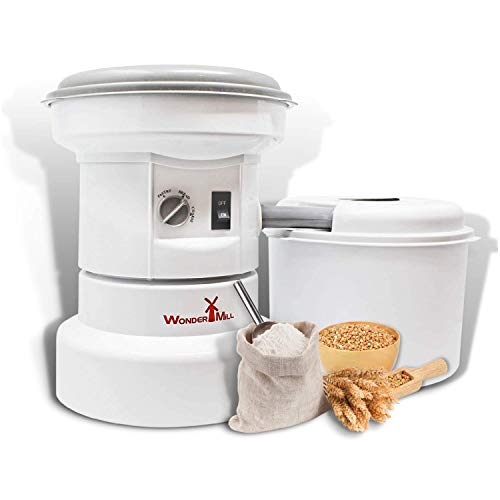
The WonderMill is the other long-running impact design here, built around a 1250-watt motor the maker sources from LG Electronics. The maker rates it at over 100 pounds of flour per hour and describes stainless steel milling fins inside a micronizing chamber. A single knob selects one of three texture settings, labelled by the maker for pastry flour, bread flour and coarse grinds.
Flour collects in an enclosed canister with a filtration tube, which the maker says keeps flour contained during milling. The listing states the mill carries UL, CSA and CE certifications, and that the milling heads are covered by a limited lifetime warranty for the original owner, with other parts covered for six years.
Specs
- Mill type: high-speed impact mill with stainless steel milling fins
- Motor: 1250 watts, per the maker
- Output: over 100 pounds of flour per hour, per the maker
- Hopper capacity: 8 cups as listed
- Texture settings: 3 (pastry, bread, coarse)
- Voltage: 120 volts
- Model number: 2-0911
- Warranty: limited lifetime on milling heads, per the maker
3. NutriMill Harvest Electric Stone Grain Mill

The Harvest takes the stone mill route in a bamboo housing. Two corundum milling stones, described by the maker as near diamond hard, grind the grain, and a 450-watt motor turns them. A texture knob adjusts the grind across the maker’s stated range, from cracked cereal at the coarse end to ultra-fine pastry flour at the fine end, so one machine covers porridge grain and baking flour.
Because the stones turn more slowly than impact heads, output per minute is lower, and the maker positions the Harvest for steady daily milling rather than bulk batches. The listing states it mills non-oily grains, beans and legumes, including wheat, rice, quinoa and lentils. The motor includes thermal protection with automatic shutoff, per the maker, and the housing is bamboo rather than plastic, which suits it to living on the counter.
Specs
- Mill type: stone mill with corundum milling stones
- Motor: 450 watts, with thermal protection, per the maker
- Texture range: cracked cereal to ultra-fine pastry flour, per the maker
- Housing: bamboo
- Hopper capacity: confirm on the listing
- Voltage: 120 volts
- Model number: 789035 (white version)
- Item weight: 16 pounds as listed
4. Mockmill 100 Stone Grain Mill

The Mockmill 100 is a compact stone mill designed in Germany by Wolfgang Mock. Its corundum-ceramic stones sit in a small housing with roughly a 6-inch square footprint, and the maker rates output at about 100 grams of fine flour per minute from soft wheat. Flour falls straight into a bowl you place under the spout, so batch size is set by your bowl rather than a built-in canister.
A lever adjusts fineness across a wide range of settings, from fine flour to coarse cracked grain, without stopping to swap parts. The maker lists wheat, rye, spelt, barley, corn, oats, millet, rice and dried legumes among the grains it can mill, all of them dry and non-oily. A 6-year warranty for home use is stated by the maker.
Specs
- Mill type: stone mill with corundum-ceramic stones
- Motor: 360 watts, per the maker
- Output: about 100 grams of fine flour per minute, per the maker
- Texture range: fine flour to coarse cracked grain, lever adjusted
- Footprint: about 6 by 6 inches, per the maker
- Model number: Mockmill 100
- Item weight: confirm on the listing
- Warranty: 6 years for home use, per the maker
5. KitchenAid KGM All Metal Grain Mill Attachment

The KGM is the outlier in this group: it has no motor of its own. The all-metal attachment locks onto the power hub of any household KitchenAid stand mixer and borrows the mixer’s motor, which makes it the smallest and lightest way into electric milling for someone who already owns the mixer. A dial offers 12 grind levels, from coarse to fine.
KitchenAid describes it as a mill for low-moisture, low-oil grains only, naming wheat, oats, corn, rice, buckwheat, barley and millet, and the Amazon listing text states it can mill up to 10 cups at a time. A cleaning brush is included for clearing the burrs between grains. The trade-offs are speed and duty: the maker directs users to the mixer’s own guidance on running time, and oily seeds, nuts and coffee are outside its stated use.
Specs
- Mill type: burr mill attachment, all-metal construction
- Power source: KitchenAid stand mixer power hub (mixer sold separately)
- Compatibility: all household KitchenAid stand mixers, per the maker
- Grind levels: 12
- Suitable grains: low-moisture, low-oil grains such as wheat, oats, corn and rice
- Batch size: up to 10 cups at a time, per the listing
- Model number: KGM
- Item weight: 4.4 pounds as listed
How to Choose an Electric Grain Mill
Start with the milling method. Impact mills like the NutriMill Classic and WonderMill are the fast option, built for filling a canister with bread flour in minutes, and their makers rate them in cups or pounds per hour. Stone mills like the Harvest and Mockmill 100 run slower and quieter by design, and they add a genuinely coarse range for cracked grain and hot cereal that impact mills do not focus on.
Next, match capacity to your baking rhythm. A 20-cup batch rating only matters if you bake several loaves a week or mill for a large household. If you mill a few cups at a time for weekend pancakes, a compact stone mill or the KitchenAid attachment covers that without taking over the counter.
Check the grain list before anything else if you cook beyond wheat. Every maker here limits its mill to dry, non-oily material, and oily seeds such as flax, along with nuts and coffee, are excluded in the listings. Legume flours are a stated strength of the NutriMill models, while the KitchenAid attachment sticks to grains.
Finally, think about where the flour lands. Canister mills contain the flour and the dust that comes with milling, while open-spout mills like the Mockmill grind into your own bowl.
Who Should Skip an Electric Grain Mill
Skip the category if you bake rarely and buy flour in small bags, because a mill earns its counter space only with regular use. Skip it too if your main interest is grinding oily seeds, nuts, spices or coffee, since the makers of all five products here restrict their mills to dry, non-oily grains and legumes.
The KitchenAid attachment is the wrong pick if you do not already own a compatible stand mixer, and heavy daily bakers may find its batch pace slow next to a dedicated mill. Anyone who needs flour during power outages should look at hand mills instead, since every product in this guide needs mains electricity.
FAQ
Can an electric grain mill grind beans and legumes as well as wheat?
Some can, according to their makers. The NutriMill Classic and Harvest listings both include dry beans, lentils and split peas among the suitable foods, and the Mockmill 100 lists dried legumes. The KitchenAid KGM is the exception here: its maker limits it to low-moisture grains. In every case the food must be dry and non-oily, so check the maker’s list for your model before milling.
What is the difference between an impact mill and a stone mill?
An impact mill spins steel heads at high speed and shatters the kernel, which makes it fast and suited to large batches of fine flour. A stone mill rubs the kernel between two stones at lower speed, which is slower, and the stone designs here also offer a coarse range for cracked grain. Both produce whole-grain flour from the same dry grains.
Can these mills grind flax seed, nuts or coffee?
No, based on the makers’ own listings. Each maker restricts its mill to dry, non-oily material, and the NutriMill Classic listing names flax and other oilseeds as unsuitable, while KitchenAid states the KGM is for low-moisture, low-oil grains and excludes peanuts and coffee. Oily material can coat the milling surfaces and strain the motor.
How fine is the flour from a home electric mill?
The makers describe pastry-fine flour from the WonderMill’s pastry setting, the Harvest’s fine end and the Mockmill 100 at its finest setting, while the impact mills adjust from fine to coarse. Texture still varies with the grain itself, since hard wheat, soft wheat and rice behave differently in the same mill, so expect to dial in each new grain with a small test batch.
Final Verdict
For most home bakers who mill weekly, the NutriMill Classic is the straightforward recommendation: a fast impact mill with large batch capacity and a long maker-stated grain list. The WonderMill matches it on speed and adds a simple three-setting dial. Choose the NutriMill Harvest or the Mockmill 100 if stone milling and a true cracked-grain range matter more than pace, and choose the KitchenAid KGM if a stand mixer already lives on your counter and your batches are small.
More from Amazon
Programs that pair well with the guide above. Offers and eligibility are set by Amazon and may change.
Set up recurring deliveries of everyday items on eligible products. Terms and savings are set by Amazon.
Explore Subscribe & SaveCollect the home and kitchen items you want in one registry that guests can shop from.
Create a wedding registryFree shipping on eligible items, Prime Video and more. Eligible new members can start with a free trial.
Start a Prime free trialAudiobooks and podcasts to listen to on the go. Eligible new members can start with a free trial.
Try Audible freeAs an Amazon Associate we earn from qualifying purchases.



Write Your Review
No reviews yet. Be the first to share your experience!