

Key takeaways
- Learn how to choose a meat grinder for fresh ground meat at home, from grinder size and motor power to plates, attachments, cleaning and food safety.
Grinding meat at home gives you control a package of store-bought ground meat cannot: you pick the cuts, fat balance, and coarseness, and know exactly when it was ground. It is also the gateway to homemade sausage. The catch: grinders vary far more than photos suggest, and the wrong pick fails one of two ways — too small for the batch, or such a chore to clean it stays in the cupboard.
This guide covers the decisions that matter: grinder size, motor figures, plates and attachments, reverse functions, and the cleaning and food-safety routine raw meat demands. The five picks below are five routes: a high-capacity standalone, a mid-size dedicated machine, a stand mixer attachment, a compact entry model, and a mainstream stainless standalone.
As an Amazon Associate, we earn from qualifying purchases.
Quick answer
Start with grinder size and batch size: a #12 or #8 standalone suits batch grinding, while a #5-class compact or a mixer attachment suits small weekly amounts. Match plates and attachments to burgers, coarse chili grind or sausage, and plan for cold meat and thorough cleaning after every session.
STX Turboforce II Platinum: the high-capacity route
The STX Turboforce II “Platinum” is the largest machine here, built around a #12 grinder head — a bigger size class than a #5 or #8. It suits serious batches: a whole deer, a bulk buy of pork shoulder for sausage day, a freezer-filling burger session (this is the black model, STX-4000-TB2-BL).
Read the motor figures carefully: the listing quotes 2000 watts of peak power under load and 600 watts running with no load, on a 110/120V supply. Its stated 175 to 225 pounds per hour on high speed is the maker’s figure, not a home-session promise. Three speeds (High, Low, Reverse) help back out tough sinew. The accessory kit is the other headline: six plates, three blades, sausage tubes, a kubbe attachment, meat claws, a burger-slider press. Pick it if batch size is your bottleneck; skip it for pound-at-a-time grinding, where cleanup outweighs capacity.
| Spec | Detail |
|---|---|
| Grinder size | #12 |
| Motor | 2000 watts peak (under load); 600 watts running (no load); 110/120V |
| Plates | 6: five grinding sizes plus 1 sausage stuffing plate |
| Extras | 3 sausage tubes with adapter, kubbe attachment, 2 meat claws, burger-slider patty press, meat pusher, high-capacity tray |
| ASIN | B0BZJSPP5S |




LEM Products MightyBite #8: the mid-size dedicated grinder
LEM is a name tied to home processing and hunting-season grinding, and the MightyBite #8 (model 1158) sits mid-range: a #8 head, a 500-watt motor as listed, and an aluminum head, auger, and meat pan. The listing positions it for regular use — a dedicated machine for households that grind often but do not need #12 throughput.
The kit covers the standard jobs: three stainless plates (coarse, fine, stuffing), a stainless knife, three stuffing tubes, and a meat stomper. The motor is permanently lubricated with a built-in circuit breaker for longer sessions. LEM sells several similar #8 machines, including a stainless BigBite line and a lighter countertop model — this pick is specifically the MightyBite #8, model 1158. Skip it for single-pound sessions; a compact model or attachment is less to store and wash.
| Spec | Detail |
|---|---|
| Grinder size | #8 |
| Motor | 500 watts as listed; permanently lubricated; built-in circuit breaker |
| Construction | Aluminum head, auger, and meat pan |
| Plates | 3 stainless steel plates: coarse, fine, and stuffing |
| ASIN | B00NTARMAE |
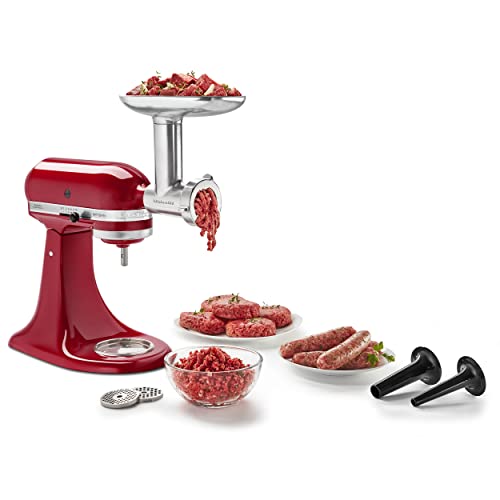
KitchenAid Metal Food Grinder Attachment: the mixer-owner route
The KitchenAid KSMMGA has no motor of its own. It is a metal food grinder attachment that runs off the power hub of a KitchenAid stand mixer. That needs stating plainly: the stand mixer is not included and is sold separately. Without a compatible mixer, it is an accessory with nothing to run it.
For mixer owners, the appeal is real: no second appliance to store, at just 2.5 pounds. The listing assigns no numbered grinder size, so do not map it onto the #5/#8/#12 scale; its pace is set by the host mixer. This is the metal model — KitchenAid’s plastic-bodied version is a different product. Plates cover fine, medium, and coarse grinds plus sausage stuffing; the box adds a removable tray, cleaning brush, food pusher, and two stuffer tubes. Warranty is one year as listed.
| Spec | Detail |
|---|---|
| Motor | None of its own — driven by the host stand mixer |
| Grinder size | Not stated in the listing |
| Construction | Metal |
| Plates | Fine, medium, and coarse, plus a sausage stuffer plate |
| ASIN | B07GK7XKJK |
Sunmile SM-G31: the compact entry point
The Sunmile SM-G31 is the small-footprint option, in the #5 size class per listing-derived specifications. Its figures show the peak-versus-rated problem clearly: sold as “Max 1HP” with 800 watts of maximum locked power, its rated power is 250 watts — the figure to plan around.
Sunmile states up to 150 pounds of meat per hour; that is the maker’s stated number, and real throughput depends on cold, trimmed meat cut into strips. Control is a simple on/off switch with no reverse, so a jam means switching off and clearing the head by hand. The unit is ETL listed, with a one-year warranty as listed, and a large sausage stuffer is included. Pick it for first-time or small-amount grinding; skip it for many-pound sessions, or if reverse matters to you.
| Spec | Detail |
|---|---|
| Grinder size | #5 class per listing-derived specs |
| Motor | 250 watts rated; 800 watts maximum locked power; sold as Max 1HP |
| Controls | On/off switch; no reverse function |
| Plates | 3 stainless steel grinding plates; stainless steel cutting blade |
| ASIN | B005EPJAY8 |
Cuisinart MG-100: the mainstream stainless standalone
The Cuisinart MG-100 is the straightforward middle option: a standalone grinder in brushed stainless steel with a 300-watt motor. Cuisinart states it grinds up to 3 pounds of meat per minute — the maker’s stated figure, not a guaranteed kitchen result. It states no numbered grinder size, so judge it by motor and plates, not the # scale.
The plate set is simpler than the STX or LEM kits: two metal cutting plates, medium and coarse, covering burgers, meatloaf blends, and chili grind. Two sausage attachments (regular and breakfast-link) and a reverse function are included, and the 34-inch cord matters if your outlet is not behind your work spot. Its listed three-year limited warranty is the longest here. Choose it for small to medium batches; skip it for very large batches or if you need a fine plate in the box.
| Spec | Detail |
|---|---|
| Motor | 300 watts |
| Grinder size | Not stated in the listing |
| Construction | Brushed stainless steel |
| Plates | 2 metal cutting plates: medium and coarse |
| ASIN | B01JCECNGS |
How to Choose
Start with grinder size. The number (#5, #8, #12) is the size class of the head and plates: bigger numbers mean a wider throat and faster feeding. A #5-class compact suits a pound or two; a #8 is the all-round home size; a #12 earns its space on many-pound sessions. Two picks here list no size number; compare by motor and plates.
Read motor figures skeptically. Listings mix rated, running, and peak power, and the biggest number is rarely the working one. The STX quotes 2000 watts peak against 600 running; the Sunmile, 800 maximum against 250 rated. Compare like with like; every throughput figure here is the maker’s own stated number.
Match plates and attachments to your food. Fine, medium, and coarse plates cover most grinds; a stuffing plate and tubes are essential for sausage, a kubbe attachment only if you make kubbe. More parts also means more washing.
Value a reverse function. Reverse backs stalled meat out of the plate for clearing. Without it, as on the Sunmile, you stop and clear the head by hand. Feed the throat only with the pusher or stomper — never your fingers.
Plan the cold chain and the cleanup. Keep meat cold from fridge to grinder — very cold, strip-cut meat grinds cleanest — working in batches too small to warm on the counter. Chill the parts beforehand if the maker’s directions suggest it. Afterwards, clean every part that touched meat per the maker’s directions, and dry parts thoroughly before storage.
Respect the maker’s limits. Follow the maker’s guidance on what can and cannot go through the grinder: these machines are built for trimmed meat, and bone, heavy gristle, and frozen-solid blocks cause stalls and damage unless the maker explicitly rates the model for them.
Who Should Skip
Skip the category if you grind once or twice a year — a butcher counter is less money in the cupboard and zero cleanup. Skip the KitchenAid attachment if you do not already own a compatible stand mixer, since the mixer is sold separately. Skip the compact Sunmile for large sessions and the STX for small ones. And skip all five for grinding bone unless the maker explicitly rates the model for it — that is a different class of machine.
FAQ
What grinder size do I need for home use?
A #5-class compact like the Sunmile suits a pound or two. A #8 like the LEM MightyBite balances regular family batches, and the #12 STX is fastest for bulk and game processing.
Can I put bones or frozen meat through these grinders?
Only if the maker’s directions for that model say so — follow that guidance on what can and cannot go through the grinder. Trimmed, very cold meat is the standard input; bone and frozen-solid meat stall or damage unrated machines. Never force a stall: switch off and clear the head by hand, or with reverse where fitted.
How do I keep home-ground meat safe to eat?
Keep meat cold at every step: refrigerate until grinding, work in small batches, and return the finished grind to the fridge or freezer promptly. Clean every part that touched meat per the maker’s directions, and dry parts fully before storing.
Is a stand mixer attachment as good as a standalone grinder?
For small to moderate amounts, yes — if you already own the mixer, which is sold separately; the attachment’s pace depends on it. For large batches or frequent grinding, a dedicated standalone such as the LEM or STX suits longer, heavier sessions and leaves the mixer free.
Final Verdict
Choose by batch size first. The STX Turboforce II Platinum is the high-capacity pick for bulk grinding, with the widest plate and accessory kit. The LEM MightyBite #8 is the balanced dedicated machine for regular use. The KitchenAid KSMMGA makes sense only for existing stand mixer owners — the mixer is not included. The Sunmile SM-G31 is the compact starting point, and the Cuisinart MG-100 the mainstream standalone for small to medium batches, with the longest listed warranty. Either way, cold meat, the right plates, and a thorough clean per the maker’s directions matter more than any single specification.
More from Amazon
Programs that pair well with the guide above. Offers and eligibility are set by Amazon and may change.
Set up recurring deliveries of everyday items on eligible products. Terms and savings are set by Amazon.
Explore Subscribe & SaveCollect the home and kitchen items you want in one registry that guests can shop from.
Create a wedding registryFree shipping on eligible items, Prime Video and more. Eligible new members can start with a free trial.
Start a Prime free trialAudiobooks and podcasts to listen to on the go. Eligible new members can start with a free trial.
Try Audible freeAs an Amazon Associate we earn from qualifying purchases.



Write Your Review
No reviews yet. Be the first to share your experience!